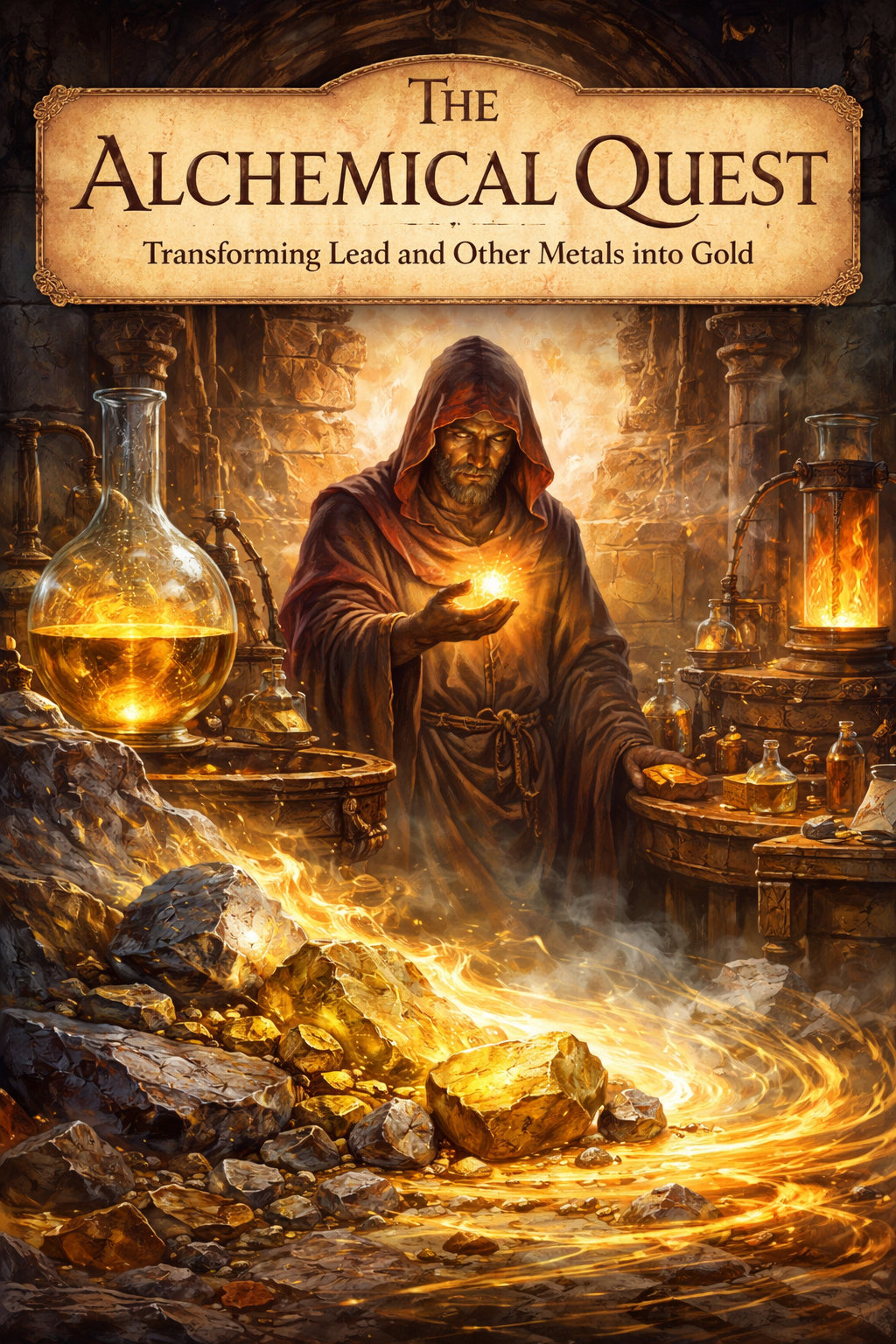
The idea of turning lead into gold is one of those enduring human dreams that refuses to fade. It lives at the crossroads of legend and laboratory: part mythic treasure hunt, part philosophical meditation, part scientific challenge. For centuries, “transmutation” meant something close to magic—an art practiced in secret, wrapped in symbols, and pursued with devotional intensity. Today, transmutation exists in a very different form: it’s real, measurable, and astonishingly expensive, carried out not with crucibles and prayers but with reactors, particle beams, and precise detectors.
What makes the story so compelling isn’t only whether gold can be made (it can), but why the desire to do so has mattered across time. In the alchemical world, transmutation promised wealth, yes—but also wisdom, purification, and spiritual renewal. In the scientific world, transmutation opened the door to understanding the structure of matter itself. Exploring both perspectives reveals a continuous thread: humans trying to learn what the world is made of, and how far transformation can go.
Alchemy is often described as a predecessor to chemistry, but that description only captures part of its identity. Alchemy was also a philosophy of change. It blended careful material experimentation (heating, mixing, distilling) with ideas drawn from religion, astrology, medicine, and metaphysics. In the ancient Mediterranean world—especially in Egypt, Greece, and later the Islamic world—alchemy developed as a set of practices and texts aimed at understanding nature’s hidden order.
Much of alchemy’s early momentum came from the belief that metals were not fixed “species,” but stages in a natural progression. In this view, lead and tin were not fundamentally different from gold; they were simply less mature, less refined, or less “perfect.” If nature could slowly grow gold within the earth, alchemists reasoned, perhaps the right art could accelerate the process.
Many names gather around the alchemical tradition, sometimes as historical figures, sometimes as legends, and often as a mixture of both:
Even where stories drift into embellishment, they point to something real: alchemy inspired intense intellectual and emotional investment. It promised that transformation was possible—of substances, of fate, and of the self.
At the center of alchemical ambition stood the philosopher’s stone, a substance said to transmute base metals into gold and—depending on the tradition—produce an “elixir” capable of healing and extending life. The stone was not simply a recipe ingredient. It was a symbol of perfection: the idea that something pure and complete could emerge from something broken and ordinary.
In alchemical texts, gold was more than a metal. It represented stability, incorruptibility, and completeness. So when alchemists described turning lead into gold, they were often describing a broader ideal: refining the chaotic into the harmonious, the impure into the pure, the mortal into the enduring.
This is one reason alchemical writing can read like poetry or coded scripture. Instructions for handling materials were frequently paired with imagery of death and rebirth, marriage and separation, darkness and illumination. The laboratory was a workshop and a temple at once.
Alchemy developed many different “systems” across regions and centuries, but a common feature was the use of staged processes—both practical and symbolic. Your draft lists classic stages often taught in modern overviews of alchemy, and they work beautifully for an essay because they capture the rhythm of alchemical thought: break down, purify, recombine, transform.
Here’s a refined way to frame those steps, emphasizing their double meaning:
Whether any alchemist truly believed these steps would reliably produce literal gold varies from person to person and era to era. But the structure itself is powerful: it turns transformation into a disciplined journey rather than a single miracle.
Alchemy did not vanish overnight. It gradually evolved. As the scientific method matured—especially during the Renaissance and early modern period—natural philosophers began insisting on clearer definitions, repeatable experiments, and publicly testable claims. Over time, the mystical scaffolding weakened, while the practical techniques remained and improved.
Distillation, filtration, crystallization, and careful measurement became pillars of chemistry. And although “turning lead into gold” fell out of the realm of realistic chemical hopes, the deeper question—what makes an element what it is?—became central to modern physics.
Alchemy wanted to perfect matter. Science asked what matter fundamentally is.
Modern science eventually discovered something alchemists could only dream of: elements can be transformed into other elements. But the mechanism is not chemical—no solvent, flame, or potion can change lead into gold through ordinary reactions. Chemistry rearranges electrons and forms molecules; it does not change the identity of an element. To transform one element into another, you must change the nucleus itself.
An element is defined by the number of protons in its nucleus:
So a true conversion from lead to gold requires changing the nucleus so that it ends up with 79 protons. That means nuclear reactions—processes powerful enough to alter atomic cores.
In high-energy environments, nuclei can be altered by bombarding them with particles (like neutrons, protons, or heavier ions) or through radioactive decay pathways. In particle accelerators, for example, a nucleus might be struck hard enough to eject protons or break into different fragments. In reactors, neutron capture can produce unstable isotopes that decay into new elements.
Scientists have produced gold atoms in tiny quantities under controlled conditions. The catch is that these methods are not like “manufacturing.” They are closer to rare, expensive transformations—proof that nature’s rules allow it, not a practical way to mint treasure.
Even when gold is produced, it may be an unstable isotope that decays into something else. Natural gold is overwhelmingly gold-197, stable and long-lasting. Some nuclear routes can produce other gold isotopes that may be radioactive. From a scientific standpoint, that’s still gold (79 protons), but it complicates any fantasy of producing usable bullion.
The idea of transmuting lead into gold tends to trigger a simple question: if it’s possible, why isn’t anyone doing it?
Because the cost is enormous and the yield is tiny.
To change nuclei, you need:
In other words, the “gold” you produce costs vastly more than gold mined from the earth. Modern transmutation is a triumph of physics, not a strategy for wealth.
And yet—this impracticality is part of the charm. The ancient dream comes true, but only in a way that reveals just how different reality is from myth.
Gold often takes center stage because of its symbolism, but the broader story of transmutation is even more interesting when you look at other examples. In fact, modern civilization depends on nuclear transmutation in multiple ways—especially in energy production, medicine, and materials science.
One of the most famous practical cases is the creation of plutonium from uranium in nuclear reactors. When uranium-238 captures a neutron, it can become uranium-239, which then decays into neptunium-239 and then into plutonium-239. This sequence demonstrates a clear, stepwise transformation from one element to another.
This is transmutation with major historical and technological consequences, showing that element-changing reactions can be systematic and large-scale—though they require highly specialized infrastructure and careful control.
Transmutation is also how many radioisotopes are made for practical use. In reactors or accelerators, stable elements can be converted into radioactive isotopes that are valuable for:
In these contexts, the “gold” isn’t a precious metal—it’s a useful isotope with a precise purpose.
Transmutation experiments have also involved converting elements like mercury or bismuth into gold isotopes under certain conditions. These demonstrations are often cited in popular retellings because they feel closest to the classic alchemical storyline. But again, the quantities are tiny, and the process is resource-intensive.
The deeper takeaway is that the periodic table is not a set of locked boxes—it’s a landscape connected by nuclear pathways, most of which are inaccessible without extreme conditions.
It’s tempting to treat alchemy as foolish superstition and nuclear physics as enlightened truth. But that misses the continuity between them. Alchemy was not only about gold; it was about process—the belief that patient work could reveal hidden structure in nature. Modern science shares that commitment, even though it rejects the mystical framework.
Alchemy asked: Can matter be perfected?
Physics asks: What is matter, and how does it change?
In both cases, the dream of transmutation expresses a human desire to participate in creation rather than merely observe it. The ancient alchemist watched fire reshape substances and imagined a grander kind of change. The modern physicist uses instruments to reshape nuclei and confirms that grander change is real.
And yet the irony remains: the closer we get to the literal dream, the less it behaves like the dream. Gold can be made—but not cheaply, not easily, and not in ways that make anyone rich. Instead, it makes us richer in understanding.
The quest to turn lead into gold has traveled a long road: from smoky workshops and coded manuscripts to particle accelerators and nuclear equations. Alchemy framed transmutation as a path to perfection, where the refinement of metal mirrored the refinement of the soul. Modern science reframes the story as nuclear transformation, where changing one element into another is possible only by altering the deepest structure of the atom.
In a sense, both are right in their own languages. Alchemy captured the human hunger for transformation—material, personal, spiritual. Science delivered a stunning revelation: nature does allow true transmutation, but on terms far stricter and stranger than medieval imagination.
So the dream endures, not because it promises easy riches, but because it reflects something timeless: the wish to understand what the world is made of, and the hope that with enough knowledge, effort, and imagination, even the heaviest “lead” can be transformed into something luminous.